
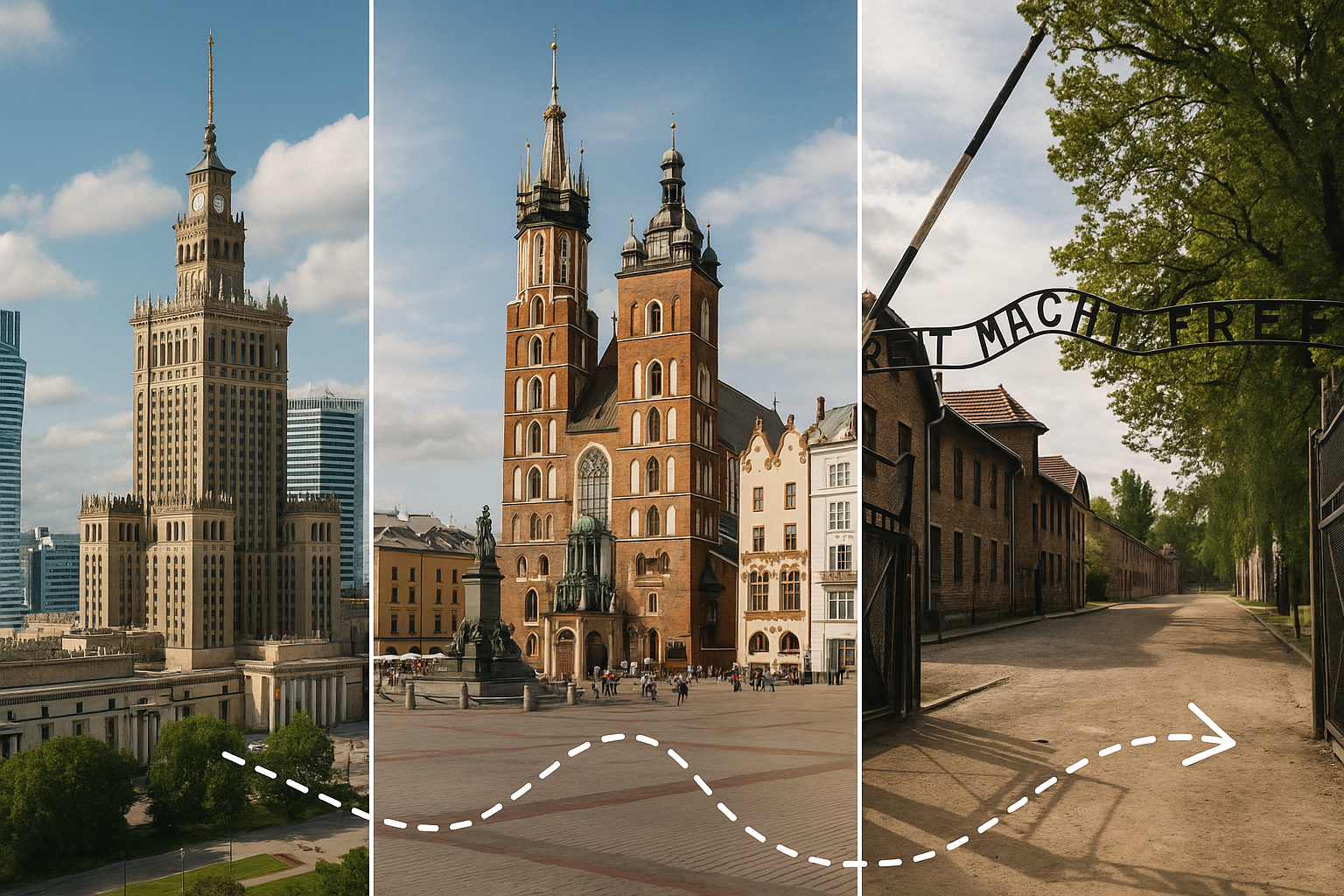
If you want to see a modern capital, the historic city of Kraków, and one of Europe’s most significant memorial sites all in one trip, what you need most is a well-paced itinerary. Such a plan can be intense, but by thoughtfully organizing the stages, you can avoid chaos, rushing, and haphazard decisions.
The best results come from treating the trip not as a series of disconnected points, but as a cohesive story of Poland: from the history of destruction and reconstruction, through the former royal capital, to a reflective visit to a site associated with World War II. This approach makes it easier to plan the sequence, choose the right tempo, and leave yourself enough space for a genuine experience rather than just ‘checking off’ attractions. English-speaking tourists looking for a practical plan usually want to combine logistics with the deeper meaning of the journey—and that is exactly how this route should be approached.
How to plan an Auschwitz tour from Warsaw without the unnecessary rush.
The most important rule is: do not try to squeeze everything into one very long day if the quality of your experience matters to you. Warsaw, Kraków, and Auschwitz form a route that can be efficiently combined, but it requires being divided into stages. The capital serves as an excellent starting point, as it allows you to first ground your journey in the context of Polish history before moving on to other sites. A visit to Auschwitz should not be treated as a mere tourist stop, but as a separate, significant part of the program that requires a calm and reflective mindset. For this reason, it is wiser to plan your stay in Kraków first and then approach the visit to the memorial site as part of the subsequent stage of your trip. Such an approach reduces fatigue and helps maintain the right balance between sightseeing and reflection.
The best order of places to visit
In practice, the following sequence works best: first the capital, then Kraków, and finally Auschwitz. This order is logical from both a historical and organizational perspective. You begin by exploring a city that showcases the experience of war, destruction, and reconstruction; you then move on to a place associated with royal heritage and culture; and finally, you visit the site of memory dedicated to the Holocaust and German occupation crimes. For those interested in visiting Poland WWII sites, this is crucial because the journey gains a clear context and avoids being just a random collection of attractions. Equally important, this sequence allows for a more natural pace without the need to constantly double back to the starting point.
Stage one: Exploring the key historical sites in the capital and building the background for the rest of the journey.
Stage two: Traveling to Kraków and focusing on its monuments, the city’s atmosphere, and its cultural significance.
Stage three: A separate, calmly planned visit to Auschwitz as the culmination of the historical part of the trip.
Why you shouldn’t try to see it all in one day
Although an intensive itinerary might seem to save time at first glance, in reality, it often strips the journey of its meaning. Long travel times, rapid location changes, and the constant need to watch the clock make it harder to focus on the substance of what you are seeing. This is especially true for a visit to Auschwitz, which requires a completely different mindset than a stroll through a city center or viewing monuments. If you add traveling between two major destinations on top of that, it is easy to turn a meaningful trip into an exhausting marathon. It is better to think of this route as a well-composed sequence of experiences, where each site carries its own weight and significance. That way, the journey remains intensive, yet stays comfortable and substantial.
Making the Warsaw to Krakow trip the core of your itinerary
The journey between these two cities should be treated not as a technical necessity, but as the axis of your entire plan. It is this very connection that forms the foundation of most trips combining history, culture, and memorial sites. A well-arranged Warsaw to Krakow trip allows you to maintain a balance between urban sightseeing and the more emotionally demanding visit to Auschwitz. From the perspective of an English-speaking tourist, it is particularly important to limit the number of decisions to be made on the spot and to establish a logical sequence of events in advance. This makes it easier to focus on experiencing the sites rather than on the day-to-day logistics of organizing every single step. The simpler the structure of the trip, the greater the chance that the journey will be both efficient and rewarding.
How to divide your trip into meaningful stages
The most useful model is to divide the trip into thematic blocks rather than random points. First, dedicate time to exploring the capital from the perspective of modern and wartime history; then, shift your focus to Kraków, a city with a different rhythm and a different layer of heritage. Only after this should you plan a visit to Auschwitz, once you have the proper context and are no longer burdened by the need to sightsee another city simultaneously. Such a division also helps to mentally organize the trip. You don’t mix a light urban stroll with the experience of a memorial site; instead, you give each part of the journey its proper significance. This is especially important for those who want to approach visiting Poland WWII sites in a mindful and responsible way.
The Urban Block: History, architecture, and the political background that begins the journey’s narrative. The Cultural Block: The former royal capital, historical monuments, and a slower pace of sightseeing. The Memorial Block: A visit to a site of exceptional historical and symbolic importance.
If you value greater organizational convenience, a ready-made guided plan can be an excellent solution, streamlining the route and reducing the risk of unnecessary delays. In this case, a Warsaw to Krakow trip with a local guide can be very helpful, especially when you want to combine efficient logistics with historical commentary and a more structured daily itinerary.
What to keep in mind for an intensive itinerary
On a route like this, the most common mistake isn’t a lack of attractions, but an excess of ambition. It is worth leaving a margin for smooth transitions between sites, a change of mood, and simple rest. This is especially important when you combine places of such vastly different character: the dynamic capital, historic Kraków, and a space of remembrance. A well-planned trip is not about filling every single moment to the brim, but about arranging the sequence so that each place can truly resonate. Mindfulness matters more here than pace. In practice, this is what determines whether, upon your return, you remember only a series of transfers or if you truly understand what you have seen.
How to combine the history of Warsaw, Kraków, and Auschwitz into one cohesive route
The most valuable historical journeys have a clear narrative. In this case, it can be a path leading from stories of occupation and destruction, through the heritage of old Poland, to a confrontation with one of the most tragic symbols of the war. Such a structure ensures that the sites do not compete with one another but rather complement each other’s meaning. For an international visitor, this is a huge advantage, as it allows for a better understanding of the Polish historical context without a sense of informational chaos. Consequently, the journey becomes more mindful rather than just logistically efficient. This is particularly precious when the goal is not just to see monuments, but to delve deeper into the theme of World War II and historical memory.
How to maintain the right balance between sightseeing and reflection
Not every place should be visited in the same way. A major city center can be explored dynamically, with shorter stops and a more flexible schedule. In contrast, Auschwitz requires a slower pace, inner readiness, and a minimum of distractions. This is precisely why it is worth consciously separating the urban sightseeing from the visit to the memorial site. Such a distinction helps organize one’s emotions and ensures the journey maintains its solemnity where it is most needed. A well-planned itinerary should therefore take into account not only the sequence of locations but also the different ways in which they are experienced.
A practical conclusion to your trip with a local organizer
If you want to combine the capital, Kraków, and Auschwitz into one well-designed route, the most sensible approach is to base your plan on a clear sequence and a realistic pace. Such a journey makes the most sense when it connects convenience with historical context and does not reduce the visit to a memorial site to a mere quick add-on. This is exactly the approach specialized in by Tour Guide Warsaw, a company operating in Warsaw that offers private and historical tours of the capital and Poland’s most important sites. If you value a cohesive organization of the entire route, the Auschwitz tour from Warsaw offer can be equally helpful, especially for those who wish to bridge the theme of World War II with a comfortable travel plan starting from the capital.