
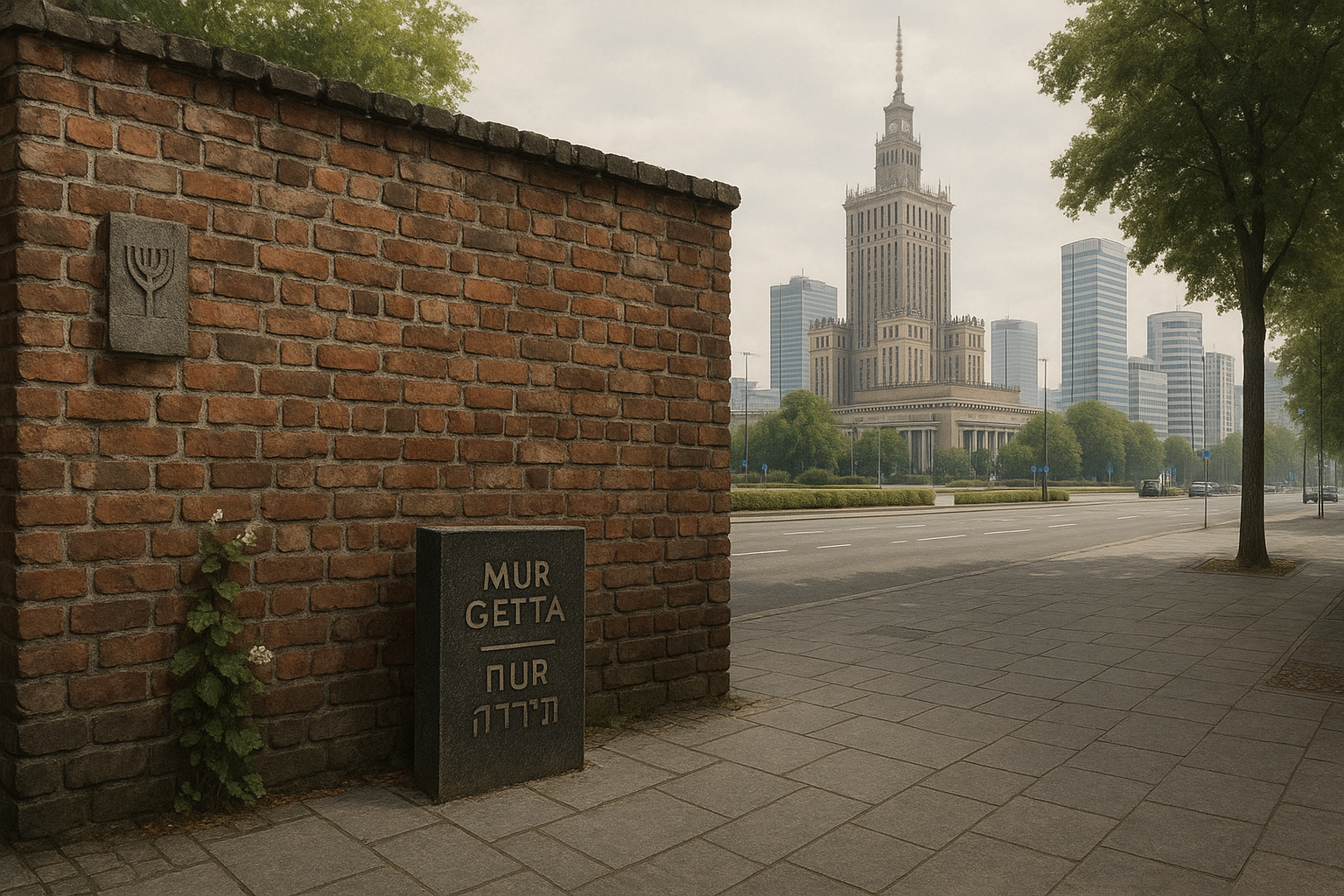
The history of the Warsaw Ghetto has not survived only in museums and archives. Throughout the city, visitors can still find tangible traces of isolation, suffering, and resistance: fragments of the ghetto wall, memorial plaques, and sites connected to the uprising. For many travelers, encountering these places becomes one of the most meaningful parts of discovering Warsaw’s Jewish heritage and wartime history.
Understanding these locations, however, requires more than simply walking from one monument to another. The surviving remnants of the ghetto are scattered across the modern city, and without proper context, it is easy to overlook their significance. That is why they should be viewed as part of a larger story about isolation, deportations, daily life, and armed resistance. This approach allows visitors not only to locate important landmarks but also to better understand what they truly represent.
How to Understand the Warsaw Ghetto Wall Location Within Today’s City
One of the most common questions asked by international visitors is: where exactly did the wall stand, and how can its traces be identified today?
The challenge is that modern Warsaw does not clearly reveal the former boundaries of the ghetto. The surviving sections of the wall represent only a tiny fragment of the vast and tragic area that once separated hundreds of thousands of people from the rest of the city. For this reason, simply searching for a Warsaw Ghetto wall location is not enough if the goal is to gain a deeper understanding of history.
Context is essential. Visitors should learn why a particular fragment survived, what role it played, and how it functioned within the system of forced isolation. Only then does a walk through the city become more than sightseeing—it becomes a meaningful journey through a place of memory.
Why a Wall Fragment Tells a Bigger Story Than Its Appearance Suggests
A preserved section of the ghetto wall is not a spectacular attraction in the traditional sense. It often appears modest, hidden in a courtyard or surrounded by modern buildings, making it easy to mistake for an ordinary remnant of old architecture.
Its true significance lies in the fact that it is a physical witness to forced confinement and the division between life “inside” and “outside” the ghetto. When visitors learn the history behind these locations, they begin to understand that the wall was not merely a structure. It was a tool of control, humiliation, and violence.
The best way to experience these remains is to take time, read the information provided on site, and connect what you see with the stories of the people who lived on both sides of the barrier. This approach is especially valued by travelers seeking a more reflective and meaningful experience.
Planning a Route That Preserves the Historical Narrative
The most rewarding route is not the one that includes the greatest number of stops. Instead, it is a walk designed so that each location contributes to a coherent historical story.
A good starting point is to visit sites that explain the boundaries of the former ghetto. From there, continue to locations connected with daily life and deportations before moving on to places associated with resistance and the uprising. This sequence helps visitors understand that the uprising was not an isolated event but the culmination of years of persecution and suffering.
Comparing today’s cityscape with historical maps and photographs can also provide valuable perspective. For those wishing to explore the subject in greater depth, a guided tour focused on ghetto history and uprising sites offers an effective way to connect individual locations into a complete historical narrative.
Memorials and Warsaw Ghetto Uprising Sites That Create a Fuller Picture
The Warsaw Ghetto is often mistakenly associated only with its wall. In reality, the memory of the ghetto is preserved through memorials, plaques, boundary markers, and locations connected with the uprising.
These places reveal that the story of the ghetto is not only one of persecution and destruction. It is also a story of dignity, documentation, cultural survival, and resistance. Visitors interested in exploring Warsaw Ghetto uprising sites should avoid viewing the uprising separately from the experiences that preceded it.
The memory of these events is layered, and each site reveals a different aspect of the same tragedy. The more thoughtfully these locations are connected during a visit, the more complete the understanding becomes.
What to Look For During a Self-Guided Visit
A self-guided walk can be highly rewarding if visitors know what to look for and how to interpret the urban landscape.
Pay particular attention to:
- Markers showing the former boundaries of the ghetto, helping illustrate the scale of isolation.
- Surviving wall fragments and memorial plaques that provide physical evidence of the past.
- Locations connected with resistance, offering insight into the dramatic circumstances surrounding the uprising.
- The modern urban environment itself, as contemporary streets often conceal the historical layout of the district.
Viewing the city in this way transforms even a short walk into a more meaningful experience. Rather than simply visiting points on a map, visitors can begin to understand how the ghetto functioned and how it is remembered today.
When a Jewish Ghetto Tour With a Historian Is Worth Considering
The history of the Warsaw Ghetto is complex, and many locations do not immediately reveal their significance. For this reason, many visitors choose a Jewish Ghetto tour Warsaw historian experience or a tour led by a guide specializing in Jewish heritage and Warsaw’s history.
A knowledgeable guide can connect individual sites into a clear narrative and help visitors avoid misunderstandings about symbols, events, and locations. This is particularly valuable for international travelers who may be unfamiliar with the broader context of Nazi occupation and World War II in Poland.
Guided tours also help explain the relationships between the ghetto wall, memorial sites, deportation points, and uprising locations. As a result, the experience often becomes far more engaging and emotionally impactful than relying solely on brief online descriptions.
Connecting Ghetto History With Warsaw’s Wider Jewish Heritage
Although the Warsaw Ghetto is a central topic for many visitors, it should not be viewed as the only lens through which to understand Jewish history in the city.
A more complete perspective includes a broader Jewish heritage Warsaw guide approach, exploring locations that reflect the richness of Jewish life before the war as well as the ways it is commemorated today. This broader context allows visitors to appreciate not only the tragedy of destruction but also the scale of what was lost and the importance of preserving memory.
Combining ghetto-related sites with other places connected to Jewish heritage creates a deeper understanding of Warsaw’s history and avoids reducing it solely to its most tragic chapter. For many travelers, this wider perspective becomes one of the most meaningful aspects of their visit.
How to Prepare for a Thoughtful Visit to the Former Ghetto Area
Proper preparation can make the experience more meaningful and respectful.
Before setting out, consider whether your goal is a quick overview of key locations or a deeper exploration of the historical context. It is also helpful to remember that this is not simply another city walk—it is a journey through a landscape of memory connected to victims, survivors, and acts of resistance.
A few useful principles include:
- Read the information at each site carefully rather than focusing only on photographs.
- Allow enough time between locations, as the modern city can change how historical spaces are perceived.
- Connect sites into a narrative that includes the wall, daily life, deportations, memory, and resistance.
- Consider joining a professionally guided tour if you wish to gain a deeper understanding of the history.
This approach helps balance knowledge, reflection, and practical orientation, turning a collection of landmarks into a meaningful historical experience.
Historical Context Gives These Places Their True Meaning
The surviving wall fragments and memorials connected to the Warsaw Ghetto gain their full significance only when viewed as part of a larger story about isolation, suffering, and resistance.
For visitors who want more than a list of locations and wish to truly understand what happened here, exploring these sites with a local expert can be invaluable. Warsaw Heritage Tours offers private and historical experiences focused on World War II, the Warsaw Ghetto, Jewish heritage, and the city’s most important places of remembrance.
Whether you want to see the remaining ghetto wall fragments, visit important uprising sites, or explore Warsaw’s Jewish heritage in greater depth, a well-structured tour can help bring the history to life.